Art at Aylesford
The Friars has a fine collection of religious modern art with sculptures, paintings, stained glass and ceramics. The restoration, followed by the building of the Shrine, began in the early 1950s when people were captivated after the distraction of the war years. The first Prior, Fr. Malachy Lynch was a charismatic figure who inspired people with the words "Courage to Build Anew
”Philip Lindsey Clark
Philip Lindsey Clark was well known to Fr. Malachy, long before the Carmelites returned to Aylesford, as Fr Malachy had commissioned the artist to create a number of statues for the Chapel of St. Mary’s College, Llandeilo in Wales. Philip Lindsey Clark was a member of the Carmelite Third Order and was the son of a sculptor and the father of a sculptor. As well as work in Westminster Cathedral and many churches, his commissions include several War Memorials. As Chair of the Religious Artist Guild, he introduced both Adam Kossowski and his son Michael Clark.
Michael Clark
Michael Clark is known mainly for his religious sculptures. His first ever commission was the little statues over the doorways of the Courtyard. He was awarded the Otto Beit Medal for Sculpture for his statue of the Glorious Assumption. Michael Clark also has a commission in Westminster Abbey.
Michael Clark, in the year after his father’s death, wrote to the then Prior, Fr. Alphonsus Brennan, in 1978. I would like to share this letter with you: “
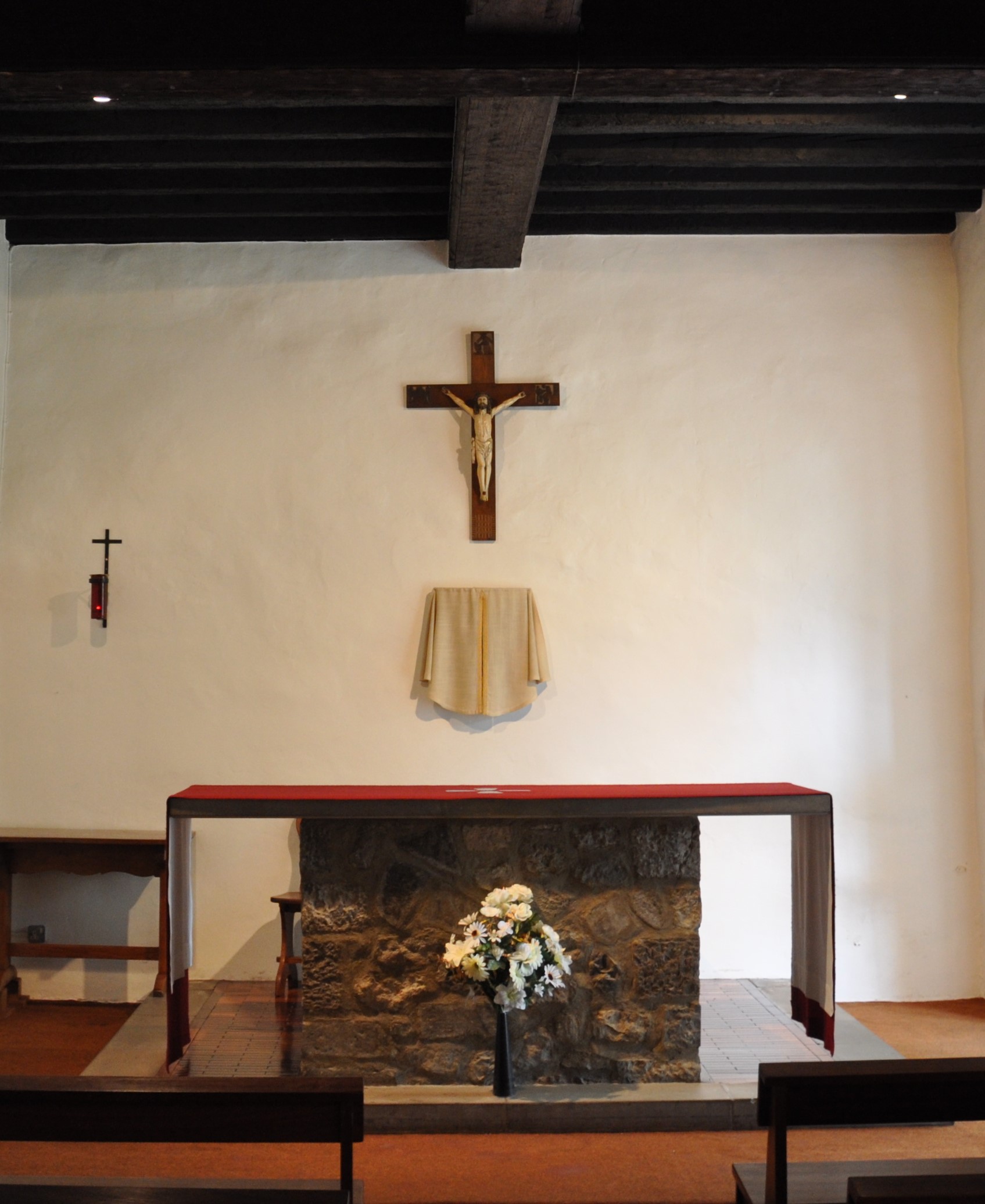
The fact that this Christmas will be the first anniversary of my father’s death takes my mind back to Christmas Eve 1949. Fr. Malachy decided, at the last minute of course, that the first Mass in the Cloister Chapel must be said on Christmas Eve. My father was summoned to Aylesford with a few days to spare to design an altar. The design was made within hours and the York stone Mensa slab was ordered from the stone masons in London to be produced in three days. Father remained at Aylesford supervising the preparation of the chapel and the building of the base for the altar. I had the unenviable task of hurrying the masons in London. All was complete in four days, and I arrived with the Mensa in the afternoon of Christmas Eve. By 7 pm all was complete, although the cement was still wet, and the first Mass of Christmas was celebrated in the Cloister Chapel. My father always loved that little chapel; for him it was the spiritual centre of The Friars. For the next twenty years I was associated with the building anew, it was a great and exciting privilege, it was a good way to work and in so doing, support my family.”
And a later letter, written in 1989, not long before he died
: “So, it is forty years since the great day, commemorated so well by Adam Kossowski in his ‘Return of the Friars’. A day I remember well. I was a young man of thirty years with six years of war behind me, just completed my Art School studies, a young growing family, and the future to face as a sculptor. I visited The Friars with my father and was captured in the excitement of Fr. Malachy’s vision for The Friars. I have much to thank God for during the last forty years, not least being the help and encouragement from Aylesford.”
Bro. John recalled that while the artist was building the Cloister Chapel altar on Christmas Eve, Fr. Malachy realised that there was no crib, so Bro. John was sent into Maidstone to buy some plaster of Paris. While Michael continued to build the altar, his father Philip created the simple Holy Family. Bro John was the model for St. Joseph.
Michael Clark is remembered for his great statue of the Assumption and for the statue of St. Joseph in the chapel that bears his name. On one of his many visits to Aylesford, he recalled that he was also very proud of the small statues over the doorways in the Courtyard, as they were his first commission.
(Left: Our Lady of the Assumption gilded statue on Main Shrine. Middle: Holy Family created by Philip Lindsay Clark. Right: Altar created by Michael Clark in the Cloister Chapel)


Adam Kossowski

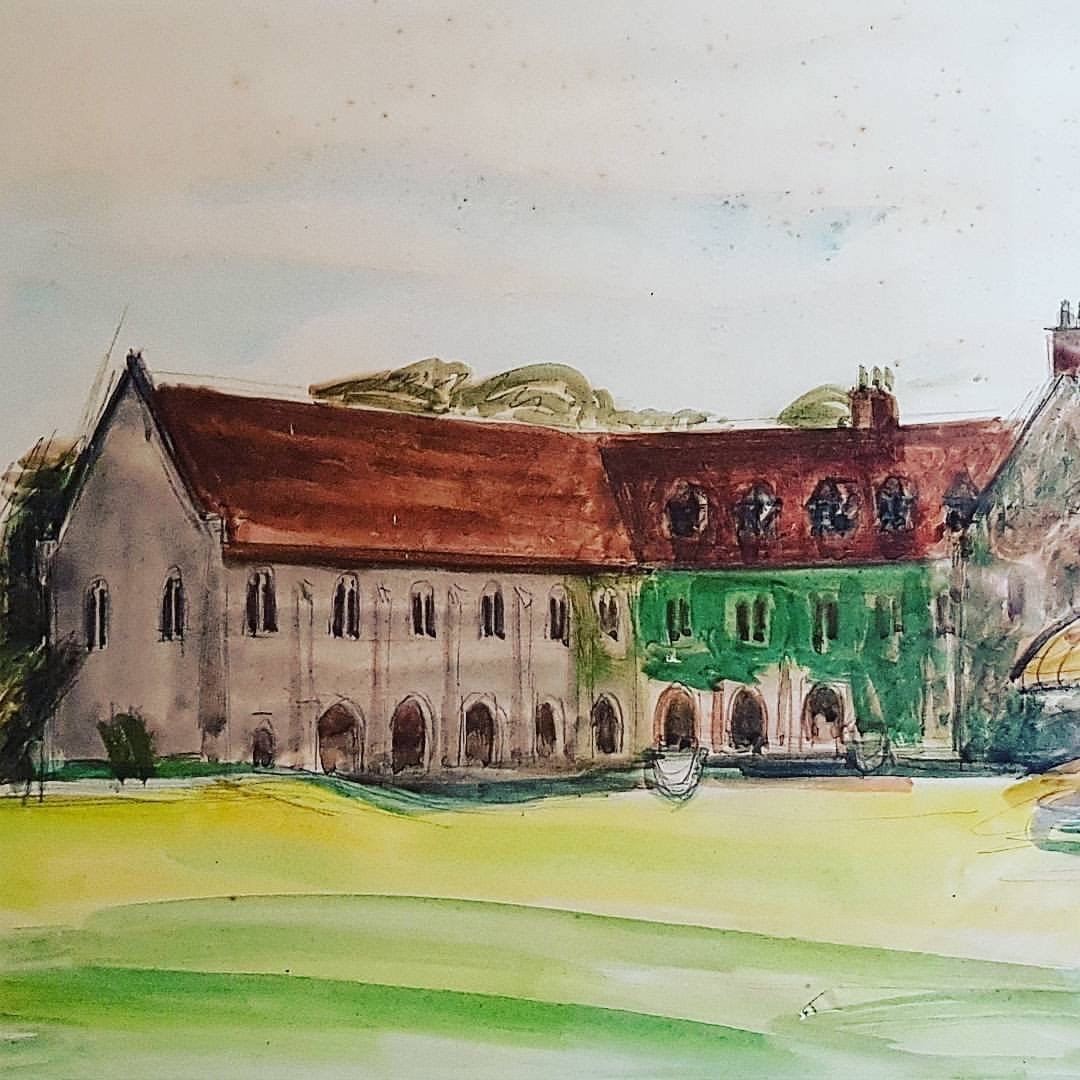


Adam Kossowski was born in Poland and studied in the Cracow and Warsaw Academies of Art. He began work at Aylesford in 1950 and worked here for more than twenty-five years. His work includes murals, scraffito, stained glass, wrought iron and most famous of all the ceramics.
A Polish Soldier’s Journey
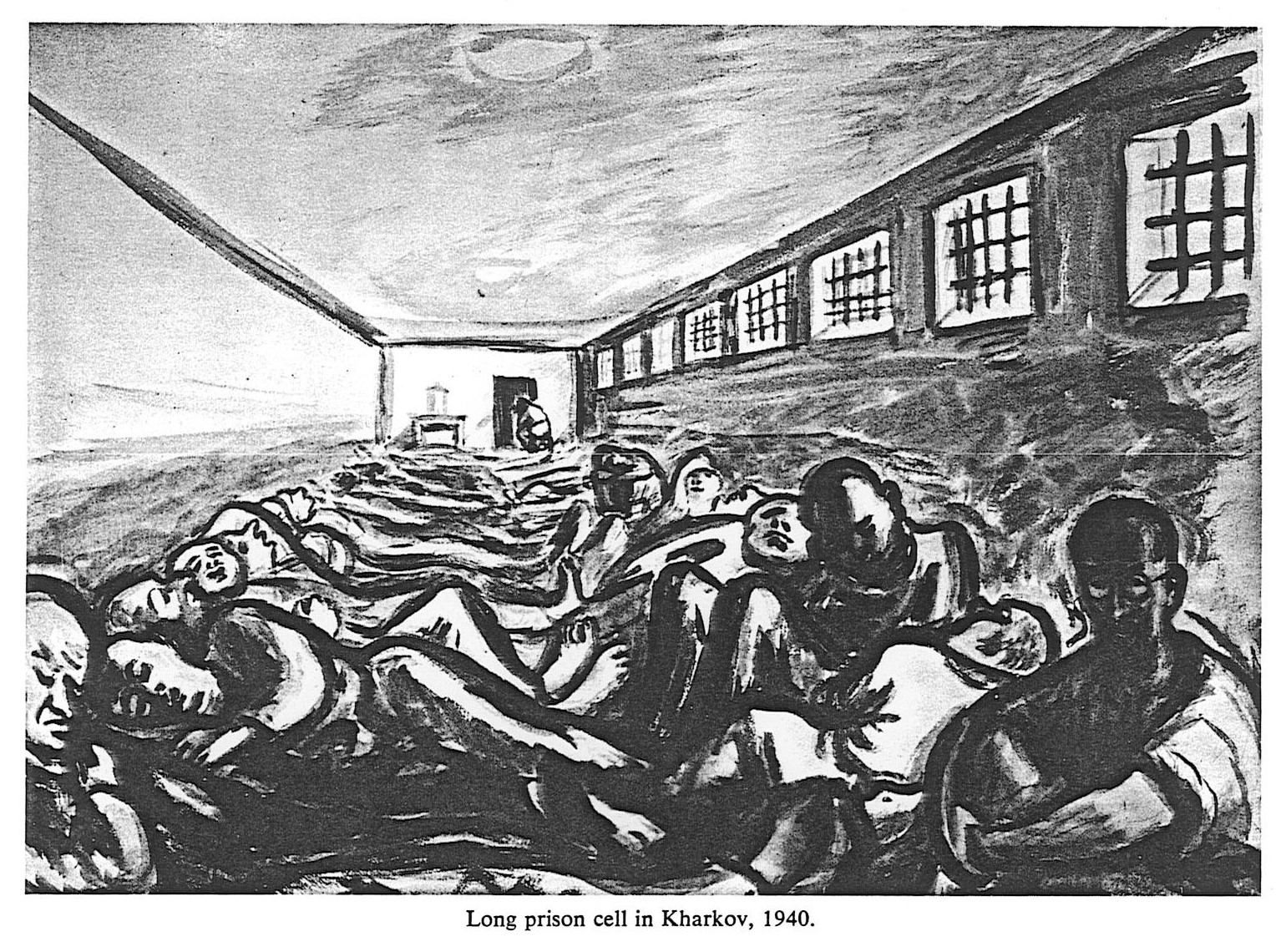
At Aylesford we have the fine Stations of the Cross by Adam Kossowski. I feel he has made these stations so graphic because he experienced pain and suffering in his own life.
Kossowski studied art in Poland between the two wars. First in Warsaw Polytechnic and later at Kracow Academy of Art. He undertook several notable commissions including the restoration of Kracow Castle and decorated the hall of the new Warsaw Central Train Station. He also spent time in Italy studying the mosaics which would later prepare him as a great ceramic artist.
In 1939, on his way to join the Polish army, he was arrested by invading Russian soldiers in Eastern Poland and promptly deported to Russia. There he was sent to the notorious labour camp at Gulag Archipelago, Siberia. He was put to work on building a railway line to Vorkuta. He remained there for three years. His deep Christian faith supported him, and he took hope in the words of Psalm 91. “You who live in the shelter of the Most High… will say to the Lord my refuge and my fortress; my God, in whom I trust”. He vowed that he would dedicate his life as an artist to the Church if he survived. He was eventually released in 1942 with the Polish and Russian agreement after Germany invaded Russia.
After travelling with the Polish army to the Middle East and later to Italy, he eventually arrived in London where he worked for the remainder of the war for the Polish Ministry of Information.
After the war he was free to resume his artistic career. He joined the Catholic Guild of Artists. He was invited by the Chair, Philip Lindsay Clark, to meet Fr. Malachy, Prior of the newly restored Aylesford Priory. Adam’s first commission was the series of seven paintings of the history of the Carmelites at Aylesford.
Already Fr. Malachy was thinking of Aylesford being a place of pilgrimage as he asked Kossowski to create what is now the Rosary Way. As these would be outside ceramics, Adam was reluctant as he did not have the experience but Fr. Malachy replied, “
I am sure Our Lady has sent you for that purpose.”
Kossowski continued to work here for the next twenty years. At his funeral in 1987, Fr. Edward Maguire said: “From clay and fire he forged a vision of the past, present and future to lift up and inspire countless others.” His story is a living reminder that even from the darkest moments, our life can lead us to a path of light and creativity.

Jaroslav Krechler
Jaroslav Krechler was a Czech artist who was responsible for the iron corpus cross in the Cloisters and the bust of Fr. Malachy Lynch in the Priors' Hall. His work can also be seen in churches in Lampeter and Faversham. He taught wood carving in Faversham until his death in 1982.

Moira Forsyth
The Stained Glass Windows
Moira Forsyth was one of the outstanding stained-glass artists of the last century. The Flos Carmeli window was a personal gift of the artist as she was received into the Catholic Church in the Cloister Chapel on the Feast of Our Lady’s birthday, 1957. The Flos Carmeli (Flower of Carmel) is the first line of a hymn that Carmelites sing to Our Lady.
The window can be seen lit up in the Cloister Chapel.

Dom Charles Norris OSB
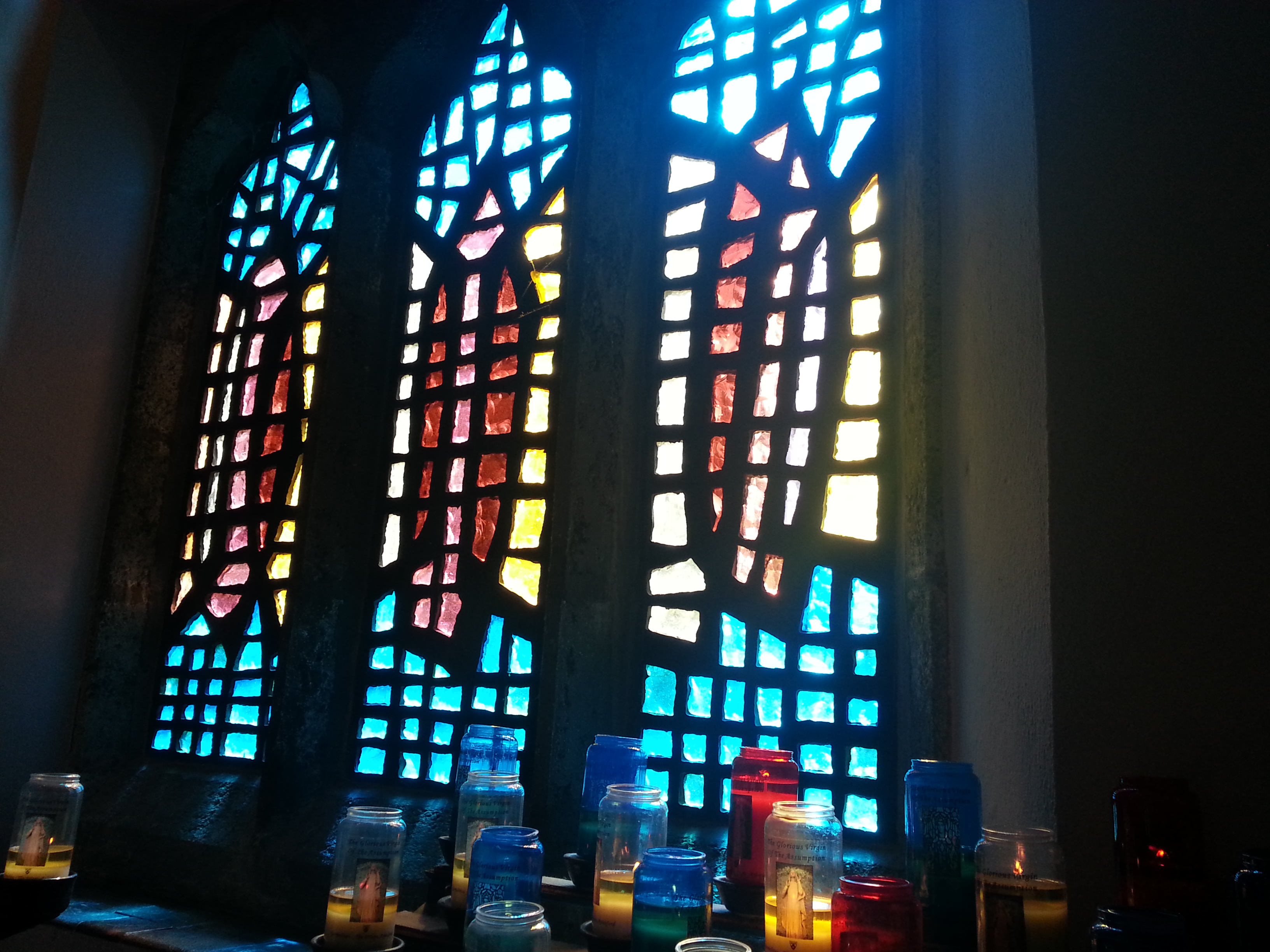
is responsible for the windows in the Relic Chapel. The ones in the body of the chapel were designed by Adam Kossowski, while the ones in the side chapel were designed by Norris himself. He developed a style of stained glass called ‘dalles de verre’ that is slab glass set in concrete, though the ones in the body of the chapel are set in resin.
Hartley Wood Glass
The diamond designed windows in the Choir Chapel; the tribune of the Relic Chapel and St. Joseph’s Chapel; the spring of faith windows in St. Anne’s Chapel and the gold, brown and orange tinted windows in the old Convent Chapel are all windows made at Hartley Wood Glass, Sunderland.
Geoff Lucas


Adrian Gilbert Scott
The chapels and Shrine area are now Grade II* listed buildings. This means that they are particularly important buildings of more than special interest. It is worth recalling that the architect of the Shrine was a member of the Gilbert Scott family, Adrian. His older more famous brother was Giles Gilbert Scott who built the Anglican Liverpool Cathedral, Battersea Power Station, what is now the Tate Modern Gallery and countless churches. Their father was George Gilbert Scott Jr. who built the Catholic Norwich Cathedral. His father, the most famous member of the family and founded the dynasty of architects was, Sir George Gilbert Scott. He is responsible for St. Pancras Train Station, the Albert Memorial, the Foreign Office; his other work included a number of workhouses and a lot of churches.
