Mary in the Gospels
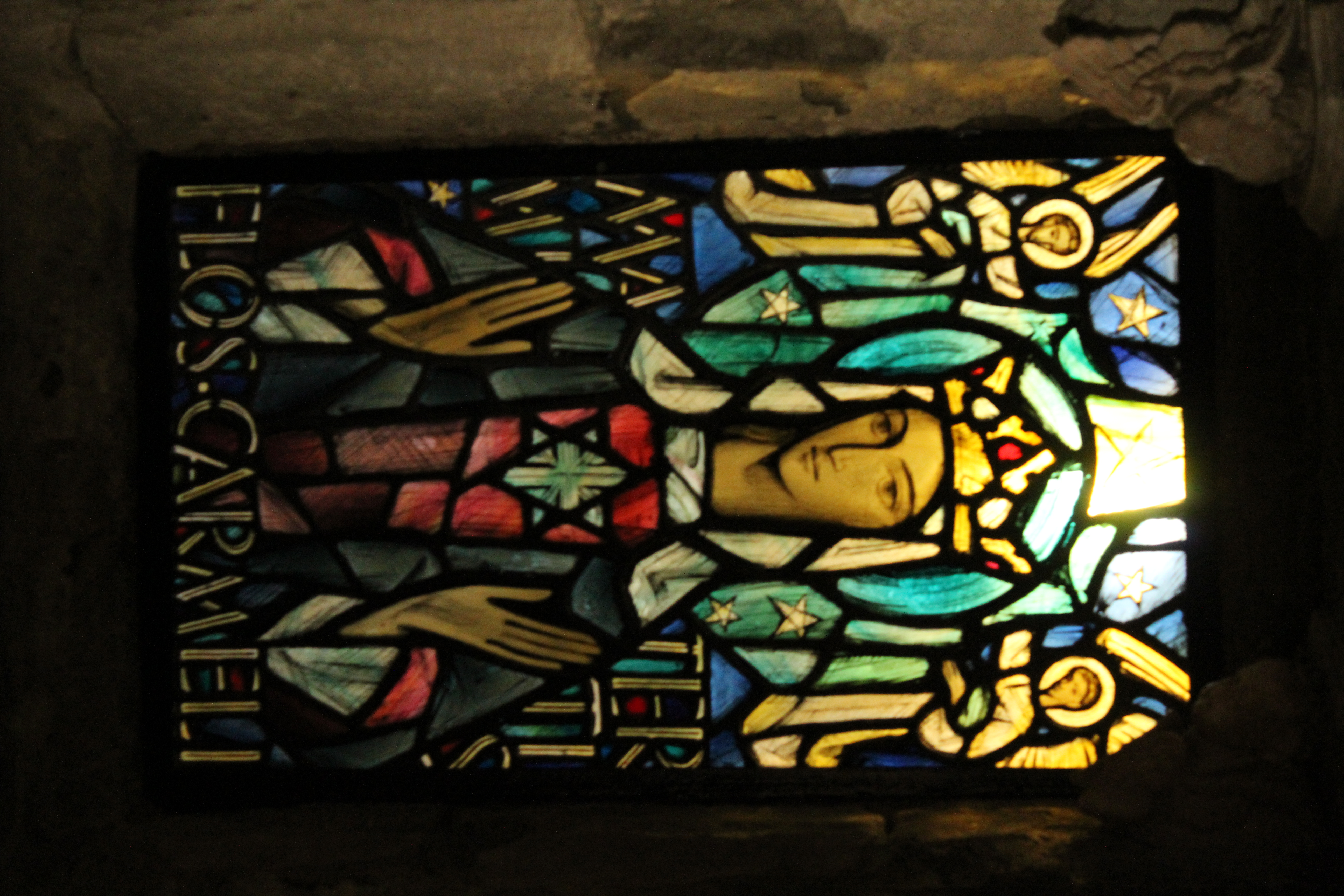
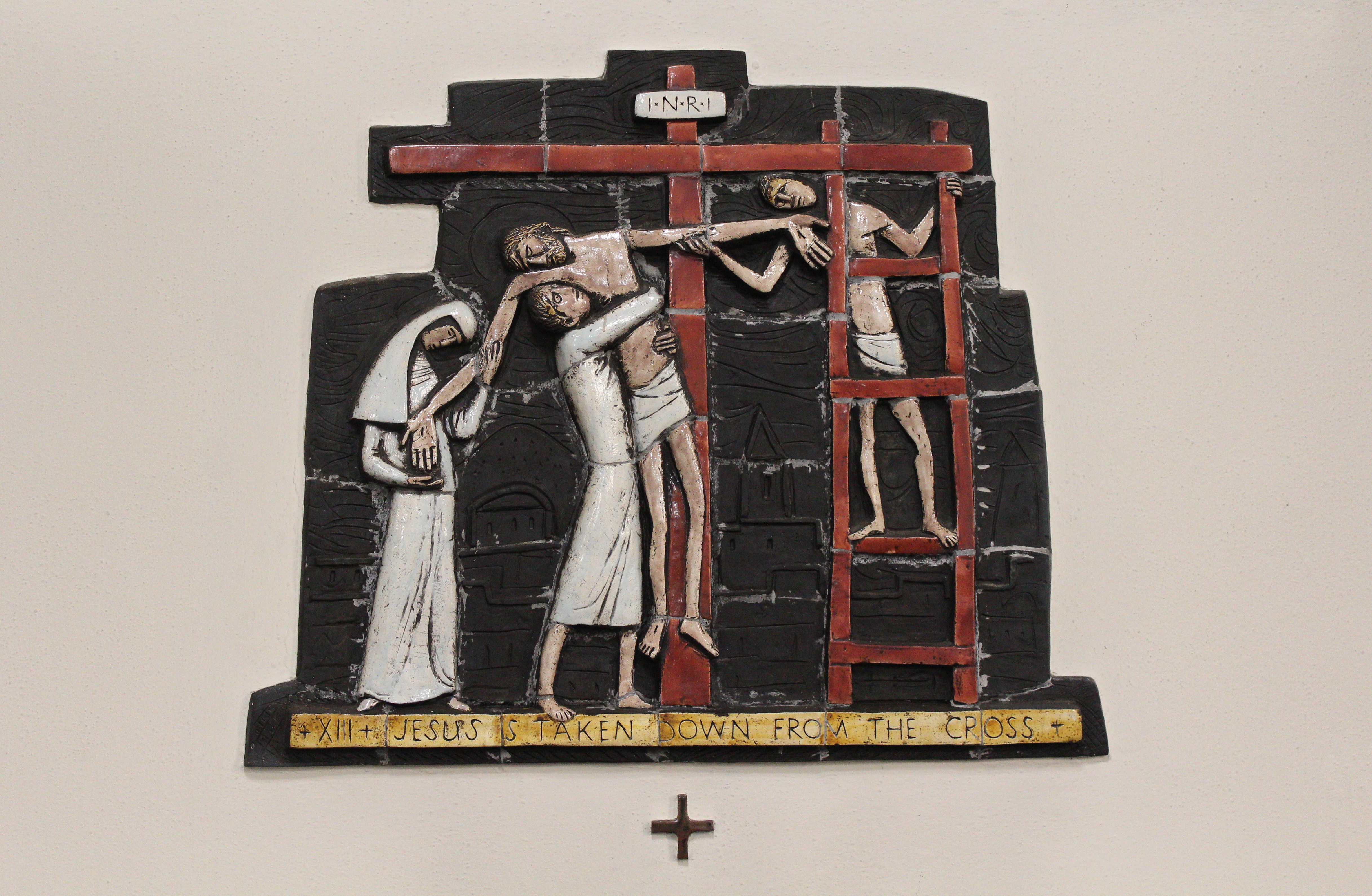
Photo Caption 1. Flos Carmeli stained glass window by Moira Forsyth Photo Caption 2. 13th Station of the Cross - Jesus taken down from the cross by Adam Kossowski
Our Lady of Mt. Carmel
2017 saw the centenary of the apparitions of Our Lady in Fatima. A few years ago, I was able to visit the shrine there. I was struck by one talk that mentioned that Our Lady often appears when the country she visits is undergoing a difficult or painful time in their history. When Our Lady visited Fatima, in 1917 Portugal, along with most of Europe, it was in the midst of the First World War. The country lost so many of their young men who did not return and those who did were never the same again. The shrine in Fatima promotes the title of Our Lady as Queen of Peace. I know many of you pray daily for peace in the world and in our communities.
What is not so well known about Fatima, is that on the sixth apparition on October 13th, Mary appeared as Our Lady of Mt. Carmel. Sr Lucia, the only visionary to live to adulthood and who later became a Carmelite Nun, when she testified to the diocesan tribunal in 1924, insisted that Our Lady on that occasion looked similar to the statue of Our Lady of Mt. Carmel which was in the parish church in Fatima. Father Killian Lynch, when he was Prior General, met Sr. Lucia who spoke to him about this aspect of the apparitions and was surprised that it had not been better reported. Our Lady appeared holding a Scapular that so many of you wear. For me the scapular is a way of following in the footsteps of Mary, who was the first disciple of Jesus. All devotion to Our Lady should lead us closer to her son. By wearing the scapular, we are deepening our baptism commitment. The first Prior of Aylesford, Fr. Malachy Lynch, suggested the daily prayer to accompany the scapular, simply: “Use me today.”
Mary in the Gospel of St. Luke
Hans Urs Von Balthasar, one of the favourite theologians of Pope St. John Paul II, has left us a beautiful reflection on the Church. In the Gospel of Luke, we see Mary is pictured as the first and most perfect of the disciples. She is the one who listens and ponders on the Word of God. Her “yes” at the Annunciation leads her to say a silent yes at the foot of the cross. At the cross she cannot do anything; she can only allow it to happen. She acknowledges that Jesus must die for her and for all humanity; she suffers with her son like so many mothers before and after her who suffer with their children.
Mary in St John’s Gospel
Many great artists have captured the suffering of Mary at the cross. The most famous being the Pieta, by Michelangelo, in St. Peter’s, Rome. Adam Kossowski created our Stations of the Cross in the Relic Chapel. In the thirteenth station we see Mary holding and caressing the dangling arm of her dead son hanging on the cross. Mary participates in the sacrifice of Jesus by letting him go back to the Father. At the foot of the cross Mary becomes the mother of all believers. Therefore, Mary is the mother of the Church and model for us all. As she bore Christ in her womb, so with faith Christ is born in our hearts.
In one sense the Church, the Bride of Christ, is Mary as God intended the Church to be in its perfection. We, as members of the Church, strive to be more like Mary in her perfection. The Church was born from the side of Jesus. In John’s Gospel we read that when Jesus had died His side was pieced with a lance; water and blood flowed from His side. This represents the sacramental life of the Church. (Jn 19:34-35). So, we strive to imitate Mary by saying yes, like Mary did, to whatever God asks us to do.
Mary at the Foot of the Cross
The Gospel for the Feast of Our Lady of Mt. Carmel comes from John (Jn19:25-27). It is a short passage but very rich. Jesus is on the cross and there also are the mother of Jesus and the beloved disciple. Jesus calls his mother ‘Woman’ which may not seem rather personal, but John is eluding to Mary being the New Eve and Jesus as the New Adam. Mary appears in the Gospel of John only twice, towards the beginning at Cana and also towards the end of the Gospel at the death of Jesus on the cross. Again, at the wedding feast of Cana, Jesus calls his mother, “Woman”.
Mary as the New Eve is undoing the disobedience of Eve by standing at the foot of the cross sharing the pain of the cross. Jesus gives his mother to the care of the beloved disciple. By doing so this represents the spiritual motherhood of Mary. She not only becomes the mother of the beloved disciple but becomes the mother of all believers and all who wish to be disciples of Jesus. She is a sign of the church in its perfection. A visible reminder of how God would like the church to be as She is the Bride of Christ.
The giving of the beloved disciple to Mary has a deeper meaning because the words “behold your son” challenge Mary’s faith as at the darkness at the cross Mary offers up her Son Jesus and accepts the beloved disciple who
takes her home. The prayers of the mass text for Our Lady of Mount Carmel also emphasise the motherhood of Mary. In the Carmelite tradition we see Mary as Patron, Queen, Sister, and Pure Virgin.
Fr Francis Kemsley O. Carm.